

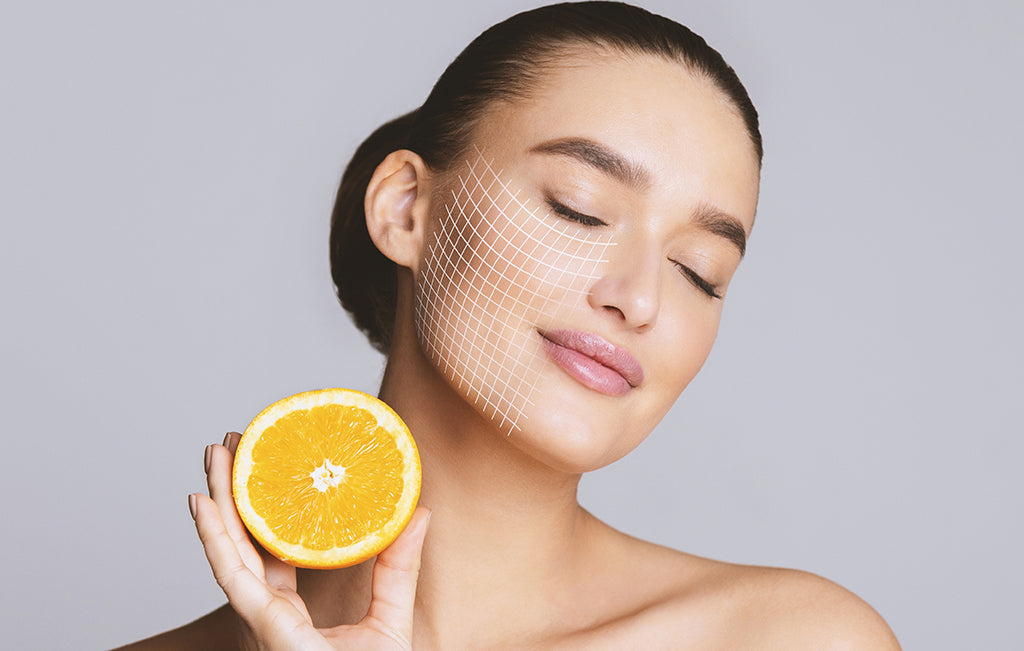
If you've ever wondered why your skin loses its bounce, its plumpness, its glow, the answer almost always comes back to one word: collagen.
Collagen is the most abundant structural protein in the human body. It forms the scaffolding beneath your skin, holds your cartilage together, and weaves through your connective tissue like a web that keeps everything firm, flexible, and intact. Radiant, healthy skin is the visible result of collagen fibres that are structurally sound and doing their job.
The problem is that scaffolding degrades over time. Collagen synthesis gradually declines with age, with studies describing an average drop of around 1% to 1.5% per year from early adulthood onward. That might not sound dramatic, but the effects are cumulative, and the skin shows it first. Fine lines deepen, elasticity softens, and the skin begins to sit differently on the face.
Why vitamin C is the missing piece
Most people associate vitamin C with immune support, but its relationship with the skin goes much deeper. Vitamin C plays a key role in collagen synthesis. Without adequate vitamin C, your body simply cannot build or maintain collagen properly. Two amino acids, proline and lysine, need to be modified before the collagen molecule holds together properly, and that process cannot happen without vitamin C as an essential cofactor.
In other words: no vitamin C, no stable collagen.
Vitamin C also acts as an important antioxidant in the skin, helping to protect cells from oxidative stress caused by UV exposure, pollution, and normal metabolism. It may also help regulate pigmentation by reducing excess melanin production, and it supports the skin barrier by maintaining the conditions needed for healthy skin repair.
All of those benefits depend on the same thing: vitamin C being present in sufficient concentration at the cellular level.
Why most collagen products miss the mark
Most people looking to address collagen loss reach for collagen drinks, collagen powders, or topical creams. The logic is understandable, but the science is less straightforward than the marketing suggests. Dietary collagen is broken down into amino acids during digestion like any other protein, and does not go straight to the skin. Topical collagen works mainly as a moisturising ingredient and does not deliver intact collagen into the deeper layers of skin where it is produced.
The more science-backed approach is to support your body's own collagen-producing machinery from within, by ensuring it has the vitamin C it needs to do the work at a cellular level.
Why absorption matters
With standard vitamin C tablets or capsules, absorption becomes less efficient as the dose increases, meaning more of the nutrient may be excreted rather than used. This is where liposomal delivery offers a real advantage.
Liposomal technology packages nutrients inside tiny lipid-based spheres that are structurally similar to human cell membranes. This helps protect the nutrient through digestion and supports its delivery into the bloodstream more efficiently than standard tablets, pills, or powders. It is a fundamentally different kind of bioavailability, and it is the technology at the heart of Altrient.
About Altrient
Altrient is a liposomal supplement brand developed by scientists at LivOn Labs. This innovative company specialises in creating science-backed formulations with simple ingredient lists, delivered in convenient single-use sachets.
All of Altrient's formulas are vegan-friendly and free of the common, undesirable additives found in many nutraceutical formulations. Every product is triple-tested for potency and purity. The single-use sachets also ensure the liposomal supplements remain stable, and make Altrient a handy option when travelling.
Altrient currently offers the following nutrients as liposomal supplements:
- Vitamin C
- B vitamins
- Glutathione
- R-Alpha Lipoic Acid
- Liposomal Magnesium
Altrient C: clinically tested results
Altrient C is a liposomal vitamin C product containing 1000mg sodium ascorbate and phosphatidylcholine. In an independent clinical trial, Altrient C was shown to increase skin elasticity by 61% in 12 weeks and reduce fine lines and wrinkles by 13.5% in 12 weeks.
The results point to what can happen when a well-absorbed, high-dose vitamin C supplement works with the body's own collagen-producing machinery. The real advantage is not just the vitamin C itself, but how efficiently it reaches the cells that need it most.
Altrient C is also beneficial for hair, with trial results showing it can reduce hair loss by 44% on average in 12 weeks and improve hair thickness by 20% in 12 weeks.
Beyond vitamin C
Altrient also offers natural antioxidants and other liposomal formulas. Altrient Glutathione provides 450mg of Setria glutathione, with trial data showing particular benefits for skin, including reducing skin redness by 81% and hyperpigmentation by 57%.
Altrient R-Alpha Lipoic Acid and Altrient Liposomal Magnesium round out the range, alongside Altrient B, a full spectrum of B vitamins with patented Quatrefolic and added minerals including zinc, selenium, and chromium.
So, if you're looking for supplements you will actually absorb, backed by science rather than sweeping wellness claims, Altrient is a sound and convenient choice backed by visible results in clinical trials.
References
[1] Myung S, Park Y. Effects of Collagen Supplements on Skin Aging: A Systematic Review and Meta-Analysis of Randomized Controlled Trials. The American Journal of Medicine, 2025; 138, 1264-1277.
[2] Boyera N, Galey I, Bernard BA. Effect of vitamin C and its derivatives on collagen synthesis and cross-linking by normal human fibroblasts. Int J Cosmet Sci. 1998;20(3):151-8.
[3] Prockop DJ, Kivirikko KI. Collagens: molecular biology, diseases, and potentials for therapy. Annu Rev Biochem.1995;64:403-434.
[4] Pullar JM, Carr AC, Vissers MCM. The roles of vitamin C in skin health. Nutrients. 2017;9(8):866.
[5] Ricard-Blum S. The collagen family. Cold Spring Harb Perspect Biol. 2011;3(1):a004978.
[6] Gelse K, Pöschl E, Aigner T. Collagens: structure, function, and biosynthesis. Adv Drug Deliv Rev. 2003;55(12):1531-1546.
[7] Sanadi RM, Deshmukh RS. The effect of Vitamin C on melanin pigmentation: a systematic review. J Oral Maxillofac Pathol. 2020;24(2):374-382.